Why DIY Ant Baits Make Your Cairns Kitchen Infestation Worse
On this page
- Why supermarket ant baits fail on Cairns ants
- Colony budding: what really happens after you bait
- Know your black ants: the three species behind most Cairns kitchen calls
- What to do about ants in your kitchen and pantry
- The bait resistance factor
- How professional colony-targeted treatment actually works
- When kitchen ants signal a bigger property problem
- What DIY ant control really costs
- Frequently asked questions about Cairns kitchen ants
You have tried the supermarket ant baits. You have sprayed the surface treatments. Yet those persistent lines of ants keep marching across your kitchen bench, seemingly multiplying overnight. If that sounds familiar, you are not dealing with ordinary ants. You are dealing with tropical Queensland species whose survival strategies make standard DIY treatments not just ineffective, but actively counterproductive.
- Most supermarket baits are built for single-queen ants. The species in Cairns kitchens often run many queens across linked satellite nests.
- Bait one of those nests and the colony does not die — it splits. One trail becomes three or four.
- Correct species identification changes the treatment. Green-head, Coastal Brown and Singapore Ants each need a different approach.
- Colony mapping plus non-repellent, slow-acting products is what actually clears the network — indoors and out.
Here is the part the hardware aisle will not mention. The ant species thriving in Far North Queensland kitchens operate under fundamentally different colony structures to the temperate ants most commercial baits were designed for. Green-head Ants, Coastal Brown Ants and various fire ant lookalikes dominate Cairns households precisely because they have evolved defences against single-queen elimination strategies.
In our work with Cairns homeowners, we see the same frustrating cycle. Someone applies a commercial bait, sees an encouraging first week, then watches the problem multiply. What started as ants in the kitchen becomes trails through the bathroom, under the deck and around the hot water system. The reason is colony budding — and it is biology, not a sales pitch.
Why supermarket ant baits fail on Cairns ants
Most supermarket ant baits are formulated for European and North American species. They are designed to poison a central queen in a single-queen colony. Tropical Far North Queensland ants did not read that script.
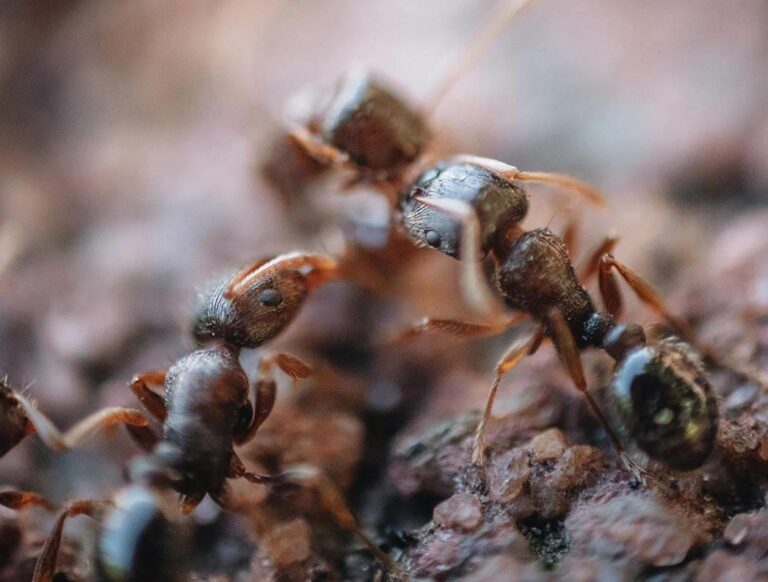
Green-head Ants — the metallic-bodied ants common across Cairns suburbs from Bentley Park to Smithfield — can carry very large numbers of reproductive females in a single colony. A bait that kills a slice of the workforce and one queen leaves the rest reproducing to replace the loss within a fortnight. Coastal Brown Ants form supercolonies with interconnected nests spanning entire streets; a bait might suppress one satellite nest while the broader network stays untouched. Singapore Ants nest in roof voids and wall cavities, where surface baits never reach the breeding population at all.
| What the bait assumes | What Cairns ants actually do |
|---|---|
| One central nest | A network of linked satellite nests, indoors and out |
| One queen to eliminate | Multiple queens, often dozens or more in mature colonies |
| Workers carry poison home and the colony collapses | Worker deaths are read as a threat and trigger emergency splitting |
| A sugar or protein lure is irresistible | Mango juice, pet food and garden honeydew outcompete the bait |
| Result: colony gone | Result: one infestation becomes several |
Colony budding: what really happens after you bait
When you place a commercial bait in your kitchen, you are assuming ants will carry poison back to a central nest with one queen. Tropical species commonly exhibit polygyne behaviour: multiple queens across interconnected satellite colonies. A well-intentioned bait application triggers colony splitting instead of collapse. Stressed colonies fragment into multiple smaller nests rather than dying out.
When worker ants start dying from bait ingestion, the colony responds with emergency protocols. Queens ramp up egg production. Workers transport brood, food stores and several queens to new nesting sites. Within days, one stressed colony becomes three or four discrete populations, and each new satellite establishes its own foraging trails.
We have seen Cairns properties go from a single kitchen trail to activity in five separate rooms after a homeowner worked through a full box of commercial baits over three weeks. The baits were not defective. They worked exactly as designed — they stressed a polygyne colony into multiplying.
Already baited and the problem got worse? Stop adding bait.
More bait means more stress, and more stress means more splitting. If you need to do something while you wait for a professional assessment, a non-repellent surface spray labelled for indoor use will at least kill foraging workers without inducing budding. Understand its limit though: it never touches the breeding population.
Know your black ants: the three species behind most Cairns kitchen calls
Black ants in Queensland kitchens typically belong to several distinct species, and each one needs a different control approach. Misidentification all but guarantees treatment failure.
Green-head AntRhytidoponera metallica
- Size
- 6–8 mm
- Look for
- Predominantly black with metallic green or bronze tinges on the head
- Nests in
- Garden beds, under pavers, inside wall cavities — multiple sites per property
- Bites?
- Yes, if disturbed. Localised pain and swelling
Coastal Brown AntPheidole species
- Size
- 2–3 mm
- Look for
- Small, dark brown to black, with persistent trails that reform after cleaning
- Nests in
- Supercolonies of linked nests that can span several neighbouring properties
- Bites?
- Not a biting risk to people
Singapore AntMonomorium destructor
- Size
- 2.5–3 mm
- Look for
- Dark, excellent climbers, arriving via ceilings and wall voids rather than the floor
- Nests in
- Roof spaces and sub-floor areas, with trails running inside wall cavities between them
- Bites?
- Not a biting risk, but known for damaging wiring and insulation
In one Cairns case we traced a Coastal Brown supercolony boundary across four adjacent properties in Whitfield. The ants ignored the fence lines entirely — workers from one end of the supercolony cooperated happily with workers from the other, because there was no genetic competition driving territorial behaviour. In high-set Queenslanders we regularly find a Singapore Ant primary nest in the sub-floor and satellite nests in the roof cavity, with the kitchen sitting in between.
Not sure which one is on your bench? Our tropical Queensland pest identification guide walks through the visual differences, and a photo sent through with your quote request is usually enough for us to narrow it down before we arrive.
What to do about ants in your kitchen and pantry
Effective kitchen ant control in Cairns needs both immediate intervention and longer-term colony management. This is the four-step framework we work through on every residential property.
-
Remove the food and water that sustains them
Store pantry items in airtight containers — including pet food, which tropical ants find particularly attractive. Fix leaking taps and improve ventilation. Green-head and Coastal Brown Ants both need consistent water, and a dripping tap under the sink or condensation behind the fridge can sustain a satellite colony indefinitely.
Then clear the residue people usually miss:
- Under the toaster and behind the microwave
- Inside the rangehood filter
- The gap between the oven and the cabinetry
- Pet bowls and the mat underneath them
-
Seal the entry points
Use a food-grade sealant around pipe penetrations and gaps in cabinetry. In Cairns homes we most often find ants entering through:
- Gaps around plumbing under sinks
- Cracks in splashback tiles
- Openings where electrical conduits pass into wall cavities
- Worn seals on external doors
- Weep holes in brick veneer — these need mesh, never sealant
Sealing reduces access. It does not remove the colony driving the infestation.
-
Stop using supermarket baits
If you have already applied commercial baits and the problem has widened, stop there. Adding more will most likely trigger further splitting. Surface sprays only kill the foragers you can see; the breeding population is untouched either way, so there is nothing to gain from escalating the DIY approach.
-
Get the colony mapped properly
Tropical species usually keep a primary nest in the garden while running satellite feeding stations inside the house. Clear the indoor activity without addressing the outdoor nest and the problem returns within weeks.
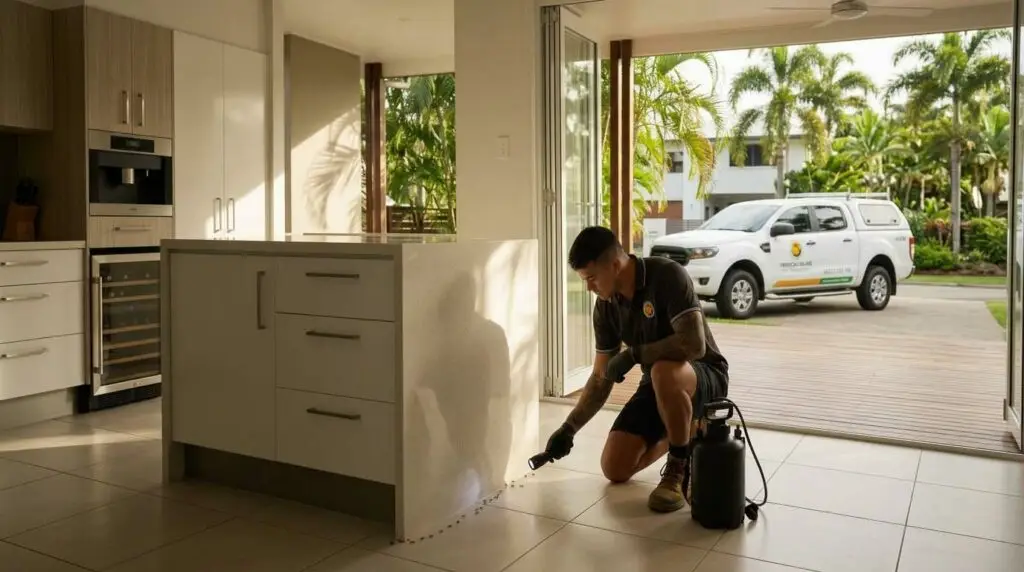
A professional assessment identifies the full spread of the colony so treatment can hit both. We use visual tracking, moisture mapping to find damp nesting sites, and species-specific behavioural knowledge to map the network across a property — and only then design a protocol that eliminates the colony without triggering a defensive split.

The bait resistance factor
Many tropical species have also developed behavioural resistance to common bait ingredients. Workers may accept a bait initially, then develop an aversion response once colony mortality registers — and that learned behaviour spreads through the network. We have watched it happen on site: after good early uptake, colonies actively avoid the same formulation within about 48 hours. Later attempts with the same product fail because the workers simply will not collect it.
Attractants are the other half of the problem. Baits designed for temperate climates lean on sugar or protein bases that tropical species find far less compelling than what is already available. Why would a Coastal Brown Ant worker take a bait pellet when there is mango juice on the bench, pet food in the bowl and honeydew-producing aphids on the gardenia outside?
Poor uptake, minimal colony impact, and a stressed network that is now splitting. That is the DIY outcome in a nutshell.
How professional colony-targeted treatment actually works
Clearing ants in a tropical environment takes a staged protocol built around colony behaviour rather than visible activity. Here is what that looks like on a real job, and there is a fuller breakdown of the options in our guide to ant control services in Cairns.
- Phase one
Colony mapping and species identification
A detailed property survey identifies nesting sites, satellite colonies and travel routes. This is where homeowners are almost always surprised. On a recent Mount Sheridan property we mapped seven discrete nesting sites belonging to a single Green-head Ant network — the owner had only noticed the kitchen trail and assumed one nest under the back deck.
Accurate identification then determines the protocol, because what works on Green-head Ants can be ineffective against Coastal Brown Ants. A technician who works with these species daily can identify most common Cairns ants on sight, which saves weeks of trial and error.
- Phase two
Targeted colony elimination
Instead of a single baiting event, treatment is staged to avoid triggering the splitting response. Non-repellent liquid products are applied to nesting sites and trail routes, then spread through the colony by contact between workers rather than relying on bait consumption. The delayed action — typically 7 to 14 days — means the colony does not register the threat until it is too late to bud.
Timing matters too. The Cairns wet season drives colonies into buildings looking for dry nesting sites, while the dry season brings heavier foraging as outdoor food gets scarcer. We work with those cycles rather than against them. There is more on that in our guide to ant control through the Cairns wet season.
- Phase three
Prevention and monitoring
Cairns has year-round re-infestation pressure, so sustained control means catching new colonies before they establish. That is regular property assessment and preventative perimeter work — not repeat business for its own sake. A property cleared in June will meet foraging workers from a neighbour colony by September without perimeter protection.
When kitchen ants signal a bigger property problem
Persistent ant activity often points to conditions that go well beyond ants. Cairns homes deal with high humidity most of the year, and structural issues like poor drainage, inadequate sealing or overgrown vegetation create conditions that favour several pest species at once.
Ants work well as an indicator species. Properties with a persistent ant problem frequently go on to develop issues with cockroaches, termites and other tropical pests that exploit the same conditions. We see it most in older Cairns homes with inadequate sub-floor ventilation: high moisture under the house attracts ants looking for water, and those same conditions are exactly what termites want.
Which is why the fix is often not a pesticide at all. Trimming vegetation back from the perimeter, redirecting downpipes away from the foundations, replacing damaged weatherboards that provide entry points — these change the pressure on the whole property, and they hold long after a treatment would have worn off.
What DIY ant control really costs
Plenty of Cairns homeowners spend a surprising amount on repeat DIY treatments that never resolve the problem. We have spoken to people who worked through $300 or more over six months on baits, sprays, granules and chalk barriers with nothing lasting to show for it.
The product spend is only part of it. Repeated infestations contaminate food stores, create hygiene problems in food preparation areas, and damage electrical components — ants are drawn to electrical fields and readily nest in switchboards and appliance junction boxes. Green-head Ants also excavate soil beneath pavers and slabs, which shows up later as subsidence and cracking.
Then there is the part nobody puts in a spreadsheet: the low-grade frustration of sharing your kitchen with ants every single morning.
Think you have found fire ants? Call Biosecurity Queensland, not us.
Fire ants are an exotic invasive species under a government eradication program, and they are easily confused with several common Cairns species. If you see mound nests in your yard, or ants with copper-coloured bodies and darker abdomens, report it to Biosecurity Queensland on 13 25 23. Reporting is free and it is the right first call.
Frequently asked questions about Cairns kitchen ants
Why do supermarket ant baits make my kitchen ant problem worse instead of better?
Tropical species like Green-head Ants and Coastal Brown Ants run multiple queens per colony, a structure known as polygyne. When a bait stresses the colony by killing workers, the surviving queens respond by splitting it into several smaller satellite nests. One ant trail becomes three or four separate infestations, often within a fortnight. Baits designed for single-queen temperate species actively backfire on Far North Queensland ants.
How can I tell if the black ants in my Cairns kitchen are dangerous or just annoying?
Most kitchen ants in Cairns are not dangerous to people, but identification still matters. Green-head Ants bite if disturbed and can cause localised pain and swelling. Coastal Brown Ants and Singapore Ants are not a biting risk to humans.
The species that genuinely matters is the fire ant, an exotic invasive pest subject to a government eradication program, which can be confused with several common Cairns ants. Fire ants cause painful stings and severe allergic reactions in sensitive people. If you see mound nests or ants with copper-coloured bodies and darker abdomens, contact Biosecurity Queensland on 13 25 23 immediately. For everything else, our pest identification guide will help you narrow it down.
What is the best time of year to treat ant infestations in Cairns?
It depends on what you mean by best. For the fastest result, treat during the dry season when colonies are foraging hard and treatment spreads efficiently through the network. For prevention, treat just before the wet season, when colonies start moving into buildings looking for dry nesting sites.
Green-head Ants are most active in the warmer months, while Coastal Brown Ants forage year-round but are easier to track in drier conditions. A professional assessment will pin the timing to the species actually on your property.
How long does professional ant treatment take to work, and will I see more ants first?
Colony elimination typically takes two to four weeks, and yes, visible activity often increases for the first few days. That is normal and expected. Non-repellent treatments cause affected workers to forage erratically before they die, so you may see more ants, more trails, or ants somewhere they have never been. It means the product is moving through the colony.
Activity then drops away quickly as the colony collapses. Complete elimination, meaning no ants at all for seven consecutive days or more, usually lands somewhere between 14 and 28 days depending on colony size and species.
Can I prevent ants coming back after professional treatment?
Largely, yes — with maintenance and monitoring. Seal entry points, remove food and water sources, keep vegetation trimmed back from the house perimeter, and maintain perimeter treatments if you are in a high-pressure area.
The honest caveat is that the Cairns climate creates constant pressure from neighbouring properties, so a treated home will eventually meet new foraging workers. Ongoing programs exist to intercept those new colonies before they establish satellite nests inside the house. It is less about ants returning and more about stopping the next colony becoming a problem.
What does ant control cost in Cairns?
It depends on the property size, the species and how far the colony network has spread, which is why every job starts with a written quote rather than a phone estimate. You can see how our pricing is structured on the pricing page, and the full scope of what is included is set out under ant control services.