Will heavy rain wash away pest treatment around my Cairns home?
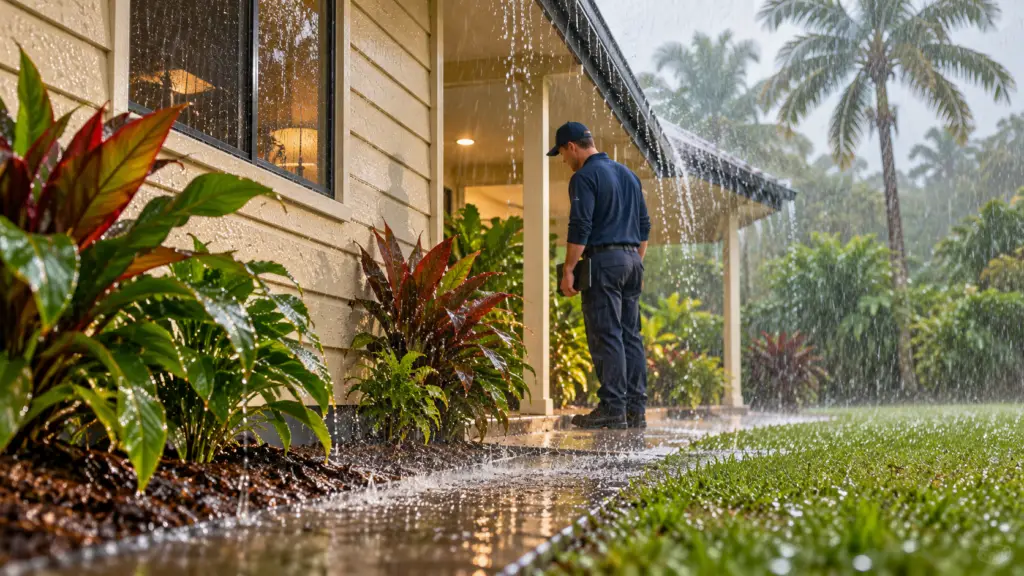
In short: no. A properly applied treatment is not washed away by ordinary heavy rain, because the products we use bind to surfaces once they have dried. The real risk is rain that falls before the treatment has set, or run-off sheeting across exposed garden beds and paths. That is why timing matters so much for pest control in Cairns wet season conditions. A sunny morning here can turn into a downpour by lunchtime.
We treat houses from Palm Cove to Gordonvale right through the build-up and the wet, and this is one of the questions we field most. Here is our honest take: a bit of planning protects your treatment far more than fretting over the forecast ever will. Let us walk through what actually happens when the rain comes.
How soon after treatment does rain affect its effectiveness?
The critical window is the drying time, usually a few hours after we spray. Most of the liquid products we use need to dry and bond to the surface before they resist water. Once that bond forms, the active ingredient sits in a thin film that holds up well to rain, humidity and foot traffic.
Here is what that means around a Cairns home:
- Rain within the first hour or two on an exposed external surface is the only scenario where a liquid treatment can be meaningfully diluted or washed thin before it sets.
- Rain after the product has dried has very little effect, because the active ingredient has already bonded to the eaves, skirting, slab edge or fence line.
- Light showers under cover, think verandahs, under eaves, inside the roof void, rarely matter at all. Those areas stay dry.
We plan around this. When we book a job in the wet, we read the radar, not just the daily forecast, and we sequence the work so external applications go down with the best shot at a dry couple of hours. If the heavens open mid-job, we adjust. We do not press on and hope.
Does rain affect outdoor treatments differently from indoor treatments?
Yes, and the gap is significant. Indoor treatments are almost entirely unaffected by rain. Outdoor treatments are the ones that need thought during the wet season.
Indoor treatments
Gel baits for cockroaches, internal perimeter sprays, work in wall voids, roof voids, subfloors and under cupboards all sit in protected, dry spots. Rain outside never reaches them. A German cockroach job, which leans on gel baiting in kitchens and bathrooms, carries on working regardless of what the sky is doing. The colony hides in warm, hidden harbourage like the motor housing behind a fridge or a dishwasher, and the bait keeps doing its job there.
Outdoor treatments
External perimeter sprays, fence lines, garden edges, retaining walls and paths are the ones exposed to weather. Heavy, driving rain across an open, sun-baked surface is far more likely to thin a treatment than a shower on a shaded wall. This is where technique earns its keep: targeting the bands where ants and cockroaches actually travel, treating under eaves and overhangs that stay dry, and choosing a product built for an exposed tropical surface rather than a generic southern template.
Mosquito work behaves differently again. Perimeter fogging and ULV knock down adult mosquitoes and treat resting zones in dense foliage. Rain then refills the very spots that breed them, a forgotten pot saucer, a blocked gutter, the cups of water that sit in bromeliads. That is why mosquito control in Cairns is never a one-and-done job. We pair the treatment with tipping out standing water around your yard.
When is the best time to book pest control during Cairns’ wet season?
The best time to book pest control in Cairns wet season is at the first sign of activity, not after weeks of rain have driven everything indoors. Waiting for a perfectly dry week between November and April is a losing game up here. A smarter approach works with the weather instead of against it.
A few practical pointers:
-
Book early in the activity cycle. Rain pushes ants, cockroaches and rodents toward the dry, sheltered parts of your home: the roof void, the wall cavities, the subfloor. Treating as numbers start to climb is far easier than clearing an established infestation.
-
Aim for a window, not a guarantee of sun. We only need a few dry hours for external work to set. Mornings often give the best run before the afternoon storms build.
-
Prioritise the inside if rain is relentless. When the wet is in full swing, internal gel baiting and void treatments deliver results no matter the forecast. We can return for external work when there is a gap.
-
Think ahead of the build-up. Treating before the heavy rain really arrives lays down a protective barrier while conditions are still manageable.
Because we are a local crew, we schedule around what the weather is genuinely doing here, not a rigid calendar. If a storm cell is parked over Trinity Beach when you are booked, we would rather talk it through than waste your treatment.
How can I tell if rain has reduced the treatment’s effectiveness?
The clearest sign is simple. Pests you thought were gone start showing up again outdoors within a week or two, particularly after a major downpour. A treatment that has held keeps knocking numbers down for weeks. One compromised on an exposed surface tends to show renewed activity right in the treated zone.
Watch for these around the home:
Ants re-forming trails along a treated path, fence or garden edge soon after heavy rain. Tropical sugar ants and coastal brown ants are relentless in the wet.
Cockroaches reappearing outdoors around the perimeter, bins or garden, while the inside stays quiet. That is a good sign the internal treatment is fine and only the external band copped it.
New activity after run-off, where water has clearly pooled or flowed across a treated area and carried product away from where pests travel.
Two things worth remembering. First, seeing a few dead or dying pests in the days after treatment is normal. That is it working, not failing. Second, indoor pests behaving themselves while outdoor numbers tick up usually points to an external touch-up, not a failed job. If you are not sure which you are looking at, a quick phone call sorts it faster than guessing.
When should I contact my pest technician about a follow-up treatment?
Give us a call whenever activity returns and does not settle within a week or two, or if torrential rain hit within a couple of hours of an external application. We would far rather hear from you early than have you living with pests marching back in. A quick chat tells us whether this is normal die-off, a weather-affected external band, or a sign the pressure around your place is unusually high.
Every general pest treatment includes a 6-month complimentary service period. If pests return inside it, the return visit costs you nothing. If heavy rain hits soon after an external treatment, give us a call on 0432 229 104 and we’ll tell you whether it needs a touch-up.
Reach out sooner rather than later if you notice:
- Activity climbing again within a fortnight, especially after a big dump of rain.
- A clear link between a storm and renewed pests in a treated outdoor zone.
- A new pressure point, such as a neighbouring build site or block clearing that pushes rodents and cockroaches your way.
We answer our own phone here, no call centre and no scripts, so you get a straight answer about whether a follow-up is worth doing and when. You can reach the team on 0432 229 104 or through our contact page.