
Flying ants or termites in Cairns? Here is the quick answer
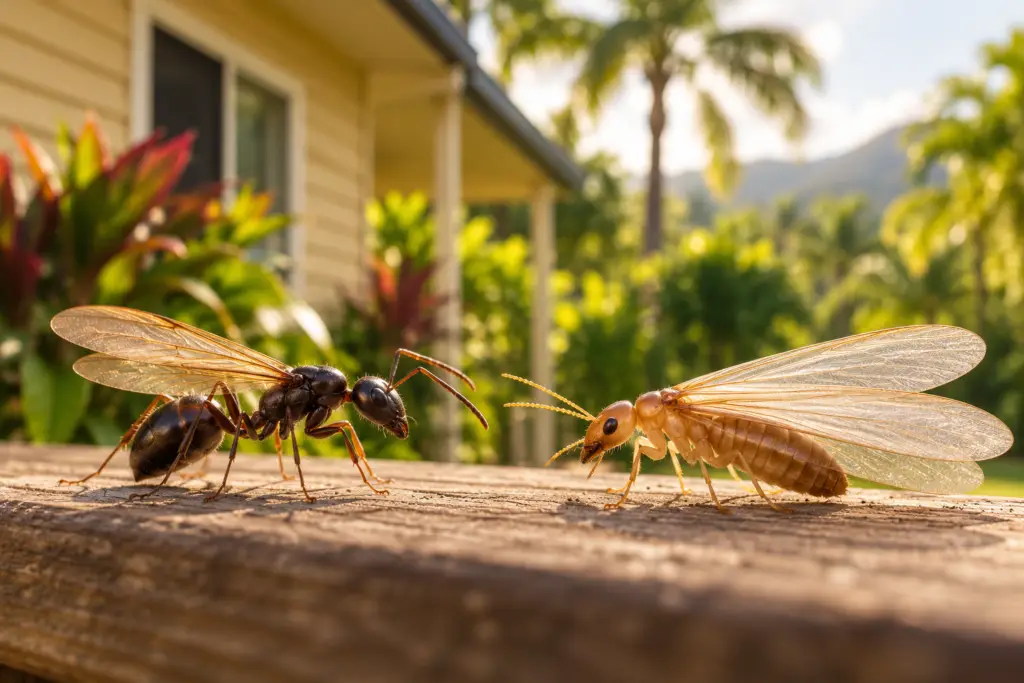
Spotted a cloud of winged insects on the veranda after a Cairns downpour? You are probably looking at either a flying ant swarm in Cairns or flying termites in Cairns, and the difference matters far more than people expect. Flying termites, properly called alates, have a straight even waist, straight antennae, and four wings all the same length. Flying ants have a pinched waist, bent elbowed antennae, and front wings clearly longer than the back ones.
Two minutes of looking closely can save you a world of grief. A flying ant swarm is a nuisance, nothing more. Flying termites can be the first visible sign that a colony is already active near your home. Our view, after working these northern beaches and city suburbs through wet season after wet season, is simple. Learn the three differences, understand why they swarm after rain, and treat a swarm as your cue to book a termite inspection rather than reach for the fly spray.
Key takeaways
- Waist: termites have a thick, straight waist; ants have a narrow, pinched waist.
- Antennae: termites have straight, beaded antennae; ants have bent, elbowed antennae.
- Wings: termites have four equal-length wings; ants have longer front wings and shorter back ones.
- Timing: both swarm in the Cairns wet season, often in warm, humid conditions after rain.
- What it means: flying ants are mostly a nuisance; flying termites near or inside your home warrant a professional termite inspection.
How can I tell flying ants and flying termites apart?
In short: look at three things. The waist, the antennae and the wings. Termites look uniform and straight all over. Ants look segmented and angular, with an obvious nip at the middle.
Here is the side-by-side version.
| Feature | Flying termite (alate) | Flying ant |
|---|---|---|
| Waist | Thick and straight, no pinch | Narrow, clearly pinched |
| Antennae | Straight, look like tiny beads | Bent, with an elbow |
| Wings | Four wings, all the same length | Front wings longer than back wings |
| Wing length | Much longer than the body | Roughly in proportion to the body |
| Colour | Often pale tan to dark brown | Usually dark brown to black |
| Body shape | One even, straight tube | Three distinct sections |
If you can safely catch one on some sticky tape or in a jar, do it. A clear specimen makes identification much easier, and it gives us something real to look at when you send a photo or call.
What differences should I look for in their wings, antennae and body shape?
Look at the wings first. They are the giveaway. Termite alates carry four wings of equal length, and those wings run noticeably longer than the body, so the insect looks clumsy and top-heavy as it flies. Flying ants carry two pairs of unequal wings, the front pair longer, the back pair shorter.
Now the antennae. Termite antennae are straight and look like a little string of beads. Ant antennae have a distinct bend, like an elbow. Once you have seen that elbow, you spot it every time.
Finally, the body. A termite has a broad, straight body with no real waist, so it reads as one smooth tube from head to tail. An ant has three clear sections and a sharply pinched middle. Colour helps too. Our local termites often look pale tan to mid-brown, while a lot of the flying ants that turn up around Cairns kitchens and patios are darker.
A note on the wings they leave behind
Termites shed their wings soon after they land and pair off, so you will often find small piles of identical, teardrop-shaped wings on windowsills, near door frames, or around light fittings. Ants hang onto their wings longer. A scatter of matching discarded wings indoors is one of the clearer signs you are dealing with termites, not ants.
Why do flying ants and termites swarm in Cairns, especially after rain?
In short: both insects swarm to start new colonies, and the Cairns wet season hands them the warm, humid conditions they need. When a colony matures, it produces winged reproductives whose only job is to fly off, pair up and set up a new nest. A short burst of flight, then down they come.
Rain is the trigger. It softens the ground and spikes the humidity, which keeps these soft-bodied insects from drying out while they are in the air. That is why a still, muggy evening after a downpour, often with the lights on inside, brings a flying termite swarm or a flying ant swarm out all at once. They cluster around windows, screen doors and outdoor lights. We get the calls the morning after, every wet season, from Trinity Beach down to Edmonton.
In Far North Queensland this is a wet-season pattern, roughly the warmer, wetter months from late in the year through to autumn. Swarms in the air are normal. What matters is where they are coming from, and whether any are getting inside. That is the point where termites and ants part ways in terms of how worried you should be.
Does seeing flying termites mean my home has a termite infestation?
Not on its own. It does mean termites are active in your area, and it is worth a check. A swarm in the open air could have come from a tree stump, a fence post, bushland, or a neighbour’s yard several houses down. Alates outside are a prompt to pay attention, not proof your home is under attack.
The picture changes when the swarm is coming from inside. Out of a wall cavity, a skirting board, a door frame, a patio post or the subfloor. Termites emerging from the structure itself, or wings appearing indoors with no obvious outside source, strongly suggest a colony is already working somewhere in or under the building. Cairns homes on concrete slabs are not immune, either. Termites track up through tiny gaps and expansion joints to reach the timber above.
So treat flying termites in Cairns as a question, not a verdict. The only way to answer it properly is to have someone inspect the timber, the subfloor, the roof void and the perimeter, then tell you whether there is active termite activity.
What should I do if I find discarded wings or swarmers inside my home?
If you find swarmers or little piles of shed wings inside, stay calm and resist the urge to spray. Reaching for the can feels satisfying, but it scatters termites and makes it harder to work out where they are coming from. Follow these steps instead.
-
Leave the area alone. Do not spray, wipe down or knock back any mud or damaged timber near where they appeared. You want the evidence intact.
-
Collect a few samples. Pop a handful of insects and some of the wings into a jar or onto sticky tape. Clear specimens make identification far more reliable.
-
Note where they came from. A window, a specific wall, a door frame, a power point, the bathroom. The location tells us a lot.
-
Take photos. Close-ups of the insects, the wings, and the spot they emerged from.
-
Call us. Ring Tropical Palms Pest Management on 0432 229 104 and tell us what you have found. We can often get a good read from your photos before we arrive.
Avoid pulling back wall linings or digging into skirtings to have a look. Active termite workings are fragile, and opening them up can send the colony deeper into the structure. Let a licensed inspection handle that part safely.
When should I arrange a professional termite inspection?
In short: as soon as you see flying termites around your home, find discarded wings indoors, or notice any sign of termite activity, such as mud tubing, hollow-sounding or blistered timber, or doors and skirtings that suddenly stick. A swarm indoors is a same-week job, not a someday one.
Even without a swarm, the climate up here makes regular checks sensible. The warmth and humidity that make Cairns such a good place to live also make it ideal for termites, which stay active all year. As a general rule for local homes:
How often to inspect
Yearly inspections as a sensible minimum for most Cairns homes. In our experience, a once-a-year check catches most termite activity before it turns into serious damage.
More often for homes with a known history of termites, nearby bushland, timber decks, or heavy garden beds and mulch pushed up against the walls.
Straight away if you have seen a swarm come from the structure, found wings inside, or spotted mud trails on foundations, piers or walls.
Tropical Palms Pest Management is Cairns-based and built for tropical Far North Queensland conditions, not run off a generic southern template. After a thorough inspection we email your report within 24 hours, and you get an onsite assessment with a fixed written quote, itemised, with no upsells and no lock-in contracts. Weighing up a purchase anywhere from Palm Cove to Gordonvale? Our pre-purchase timber pest reports follow AS 4349.3 and are usually arranged within 48 hours of your call.
Just watched a swarm come off the veranda and not sure what you saw? Send us a photo or give us a ring. We answer our own phone, no call centre and no script, and we will tell you honestly whether it is worth a closer look.
Frequently asked questions
Are flying ants dangerous to my home like termites are?
Not in the same way. Flying ants are mostly a seasonal nuisance and do not eat the timber in your house the way termites do. Termites feed on the cellulose in timber and can cause real structural damage over time, which is why getting the identification right matters so much.
I sprayed the swarm before I knew what it was. Have I made it worse?
Probably not disastrously, but if they were termites, spraying can scatter them and make it harder to trace where they came from. Stop spraying, leave the area undisturbed, keep a couple of samples if you can, and give us a call so we can take a proper look.
How long does a flying termite swarm last?
Usually not long. A swarm is a short burst, often an hour or two on a warm, humid evening after rain, and then it is over. The swarm ending does not mean the risk has passed, because the termites that paired off are out hunting for timber and moisture to start a new colony.
Can termites get into a concrete slab home in Cairns?
Yes. A concrete slab is not a termite-proof barrier on its own. Termites can travel up through small cracks, gaps and expansion joints to reach the timber framing, skirtings and roof above, which is why slab homes still need regular inspections.
Do you offer a free termite inspection?
We do not advertise free termite inspections. What we offer is a thorough inspection to AS 3660.2 with the report emailed within 24 hours, plus an onsite assessment and a fixed written quote with no upsells and no lock-in contracts, so you know exactly where you stand before any work begins.

